
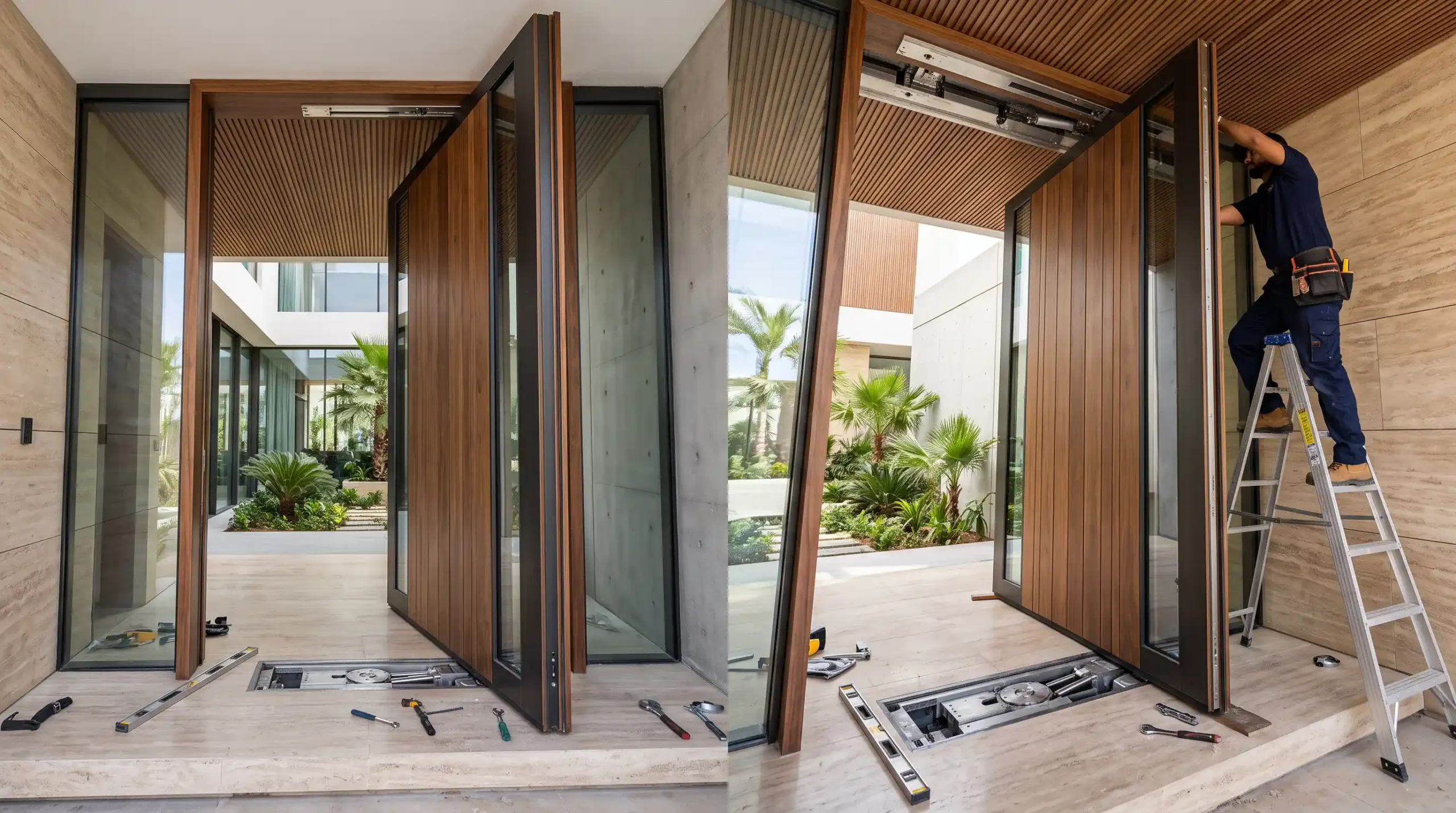
Choosing among the types of pivot hinges determines how smoothly a heavy or statement door operates for years. For homeowners in Dubai, the right hinge affects weight capacity, swing direction, appearance, and durability in a hot, dusty climate. Pivot hinges carry a door on a vertical axis rather than side hinges, enabling large panels. This guide explains each type, its uses, and how to choose, so you specify the right hardware with confidence.
Quick Facts!
- The main types of pivot hinges are offset, center hung, concealed, double acting, and self closing, each suited to different door weights and uses.
- Offset pivots are the most common for entrances, center hung suit two way swing, and concealed pivots give a clean, hidden look.
- Pivot hinges carry weight through the floor and top, so they handle far heavier and larger doors than standard side hinges.
- For doors in Dubai, corrosion resistant stainless or quality hardware and correct floor support matter most for smooth long term operation.
Types of Pivot Hinges
The main types of pivot hinges differ in where the pivot point sits and how the door swings. Unlike a standard butt hinge that hangs the door from one side, a pivot hinge rotates the door on a vertical axis carried at the top and bottom, distributing weight to the floor. This is why pivot hinges suit heavy, tall, and oversized doors.
Below are the main pivot hinge types, each explained with its typical uses so you can see which fits your door.
1. Offset Pivot Hinges
An offset pivot places the pivot point away from the door edge, toward the hinge side, so the door swings predominantly in one direction and sits neatly against the frame when closed. Offset pivot hinges are by far the most common pivot type in commercial storefront and entrance applications. They give a clean, architecturally integrated look and clear a protruding or recessed frame stop.
2. Center Hung Pivot Hinges
A center hung pivot places the pivot point closer to the middle of the door, allowing it to swing in both directions. The hardware is completely concealed once installed, only the floor plate is visible, providing a clean, minimal look, which is why center hung pivots are popular on storefront glass doors and two way traffic doors.
3. Concealed Pivot Hinges
A concealed pivot hinge hides the mechanism inside the door and frame, leaving little or nothing visible. This suits contemporary interiors and frameless glass doors where a minimal, hardware free appearance is the priority, giving the door a clean, seamless look.
4. Double Acting and Self Closing Pivots
Double acting pivots let a door swing both ways and return to center, ideal for high traffic two way access. Self closing pivots, available in spring or gravity types, automatically return the door to closed, common where controlled closing is needed.
| Pivot Type | Pivot Position | Swing | Best For |
|---|---|---|---|
| Offset | Near hinge edge | One direction | Entrances, storefronts |
| Center hung | Near door centre | Both directions | Glass doors, two way traffic |
| Concealed | Hidden in door | One direction | Minimal, frameless looks |
| Double acting | Centre | Both, returns to centre | High traffic doors |
What Are the Advantages of Pivot Hinges?
Pivot hinges offer benefits that side hinges cannot match, especially on large or heavy doors.
-
Superior Weight Capacity
Because a pivot hinge carries the door’s weight through the bottom pivot to the floor rather than the frame, it supports far heavier and larger panels. Pivot hinges can carry far more weight than standard butt hinges and are the right choice for extra heavy, oversized, or high traffic doors. This makes them ideal for grand aluminium and glass doors.
-
Clean, Modern Aesthetics
Pivot hinges, particularly concealed and center hung types, leave minimal visible hardware, creating a sleek, contemporary look. This suits modern villas and design led interiors where clean lines matter.
-
Durability and Reduced Frame Strain
By transferring load to the floor, pivot hinges reduce strain on the frame, helping the door stay aligned and last longer. This is valuable for large entrance doors that see daily use.
What Are Pivot Hinges Used For?
Pivot hinges appear across residential and commercial settings wherever large or statement doors are needed.
1. Residential Entrances and Statement Doors
Pivot hinges are popular for villa front entrances and interior statement doors, where a large, dramatic panel makes an impression. They suit the bold architectural style favoured for premium properties in Dubai.
2. Glass and Frameless Doors
Frameless glass doors rely on pivot systems to carry heavy panels cleanly without bulky framing. The hidden hardware supports large glass while keeping the minimal look these doors are chosen for.
3. Commercial and High Traffic Doors
In commercial projects in Dubai such as offices, retail, and hospitality, double acting and center hung pivots handle two way traffic and frequent use, offering durability where standard hinges would wear quickly.
How Do I Choose the Right Pivot Hinge?
Selecting the correct pivot hinge depends on door weight, swing direction, appearance, and installation context.
Match the Hinge to Door Weight and Size
Heavier and taller doors need pivots rated for the load, sometimes with an intermediate pivot for support. Confirm the door weight and dimensions so the hinge and floor can carry them safely.
Consider Swing Direction and Use
Choose offset for a clean one direction entrance, center hung or double acting for two way swing, and self closing where controlled return matters. Match the hinge to how the door will be used daily.
Factor in Finish and Climate
For durability in the UAE, choose corrosion resistant finishes such as stainless steel and quality mechanisms that cope with heat and dust. These support smooth operation and long life for external and heavily used doors.
Get Premium Pivot Door Systems from Nitrex Tech
Understanding the types of pivot hinges helps you specify a door that operates smoothly and lasts. Match the hinge to your door’s weight, swing direction, and look: offset for clean entrances, center hung for two way glass doors, concealed for minimal designs, and double acting for high traffic. Confirm floor support and corrosion resistant hardware for Dubai conditions. To explore quality pivot doors for sale and expert guidance, speak to Nitrex for advice tailored to your project.
FAQ’s
What is the difference between top pivot and bottom pivot?
The bottom pivot carries most of the door’s weight and transfers it to the floor, while the top pivot anchors and stabilises the door at the frame head. Together they form the single rotating axis.
Which type supports the heaviest doors?
Offset and center hung floor mounted pivots, often with an intermediate pivot, support the heaviest doors because they carry weight through the floor. The specific rating depends on the manufacturer’s specification.
Are concealed pivot hinges better than exposed?
Concealed pivots offer a cleaner, minimal look favoured in modern design, while exposed pivots can be easier to access and adjust. Neither is universally better, it depends on aesthetics and maintenance preference.
Can pivot hinges be used on glass doors?
Yes. Pivot hinges are commonly used on frameless glass doors, carrying heavy panels cleanly without bulky framing. Center hung and concealed pivots are especially suited to glass for their minimal appearance.
Do pivot hinges work on exterior doors in Dubai?
Yes. Pivot hinges work well on exterior doors in Dubai when specified with corrosion resistant finishes and weather rated mechanisms suited to the heat, dust, and coastal air found across the UAE.
How long do pivot hinges last?
Quality pivot hinges can last many years, often the life of the door, with routine care. Durable stainless or alloy hardware and periodic cleaning of the pivot points support long service.
Can pivot hinges be replaced without changing the door?
Often yes, if a matching pivot system is available and the door and frame preparation suit it. A specialist confirms compatibility before replacing the hardware.
Which type is best for large aluminium doors?
Offset or center hung floor mounted pivots are best for large aluminium doors because they carry the significant weight through the floor and keep the panel aligned over time.
Do pivot hinges require floor reinforcement?
Heavy doors with floor mounted pivots may need a reinforced recess or floor support. Confirm structural requirements before installation, as this is far easier to plan than to retrofit.
Are offset pivot hinges better than center pivot?
Offset pivots suit clean one direction entrances and sit neatly against the frame, while center pivots allow two way swing. The better choice depends on whether you need one way or both way movement.
Can pivot hinges support automated doors?
Yes. Certain pivot systems can be integrated with automation for effortless operation, which suits heavy or commercial doors. Confirm automation compatibility with the manufacturer for your system.
Which type needs the least maintenance?
Simple offset and center hung pivots generally need little maintenance beyond keeping pivot points clean. Self closing and automated systems have more components, so they benefit from periodic servicing.
What is the difference between a pivot hinge and a floor spring?
A pivot hinge is the rotating point that carries and guides the door, while a floor spring is a mechanism set in the floor that also controls closing. A floor spring combines pivoting with a closing function.
Do pivot hinges affect door alignment over time?
Quality pivot hinges help maintain alignment by transferring load to the floor and reducing frame strain. Poor quality hardware or an unsupported heavy door can drift, so specification and installation matter.
Which type is most common in Dubai villas?
Offset and concealed floor mounted pivots are common in Dubai villas for large entrance and statement doors, valued for their weight capacity and clean, modern appearance.